Tree Removal Service
Reliable and Experienced Expert Tree Removal Services
Removing a tree can be an extremely hazardous and complicated task. In order to accomplish this task in a safe manner, it is necessary to have the proper equipment and knowledge, as well as sufficient time to plan out the removal process. The certified arborists at Seattle Tree Trim and Removal have completed the removal of thousands of trees in Seattle. These included large evergreen trees that were so tall they towered over houses and/or power lines, and also many smaller ornamental trees.
Removing a tree is never an easy decision to make. There are many reasons why you may need to consider removing a tree on your property. These include hazards due to dead branches, disease, or pest infestation; clearance of land for new construction projects; or simply because the tree no longer fits into your landscaping vision. Whatever your reason for wanting to remove a tree, the certified arborists at Seattle Tree Trim and Removal will assist you throughout the entire process with professionalism and respect for your property.
Every one of our tree removal projects starts by assessing the tree being removed, any structures near the tree, and any potential hazards that could exist during the removal process. After completing these assessments, we create a custom removal plan for each client. This removal plan was created to ensure that the removal of the tree occurs in a safe manner and has the least amount of impact on the clients’ property as possible. Our services include all phases of the removal process, including the removal of the tree itself, cutting and hauling of branches and debris, and the clean-up of the job site. Upon completion of the removal project, the clients’ property is ready for their next step.
When Is It Time To Remove a Tree?
Why Do Trees Need to Be Removed?
Hazardous Conditions – A tree that is unstable and leaning against a home, car, or other traffic area is hazardous. A dead or dying tree has brittle limbs that could fall at any time, placing people and property at risk, as well as creating liability issues.
Disease and Decay – If a tree is diseased internally or has rotted from within, it will typically have no chance of being saved. By removing these types of trees, you are stopping the transmission of diseases to healthy trees and eliminating the risk of sudden structural failure.
Windstorm Damage – Seattle’s windstorms can snap trunks, uproot trees, or break off large branches. A severely damaged tree may be beyond repair and will need to be completely removed for safety purposes.
Land Clearing For Construction/Development – Land clearing for new buildings, additions, or landscaping changes usually requires the removal of trees. We assist contractors and homeowners by clearing land efficiently and preserving any trees that were chosen to stay.
Tree Overcrowding – When there are multiple trees in one location, each competing for sunlight, water, and nutrients, the overall health of all the trees suffers. Strategic removal of some trees will allow the remaining trees to grow healthier and create a better balance of plants in the landscape.
Aggressive Root Systems – Some trees have an aggressive root system, which can harm foundations, driveways, sidewalks, and underground pipes. When using root barriers or pruning does not eliminate the problems, removal is likely the best option.
Trees in Poor Locations – Trees that are too close to homes or structures; block views you would like to see; interfere with solar panels, or are creating excessive shade in locations where you wish to plant a garden or grass may need to be removed for functional purposes.
Non-Native Invasive Tree Species – Non-native invasive tree species can dominate over native species and upset the ecosystem locally. By removing these non-native invasive tree species, you can help restore your landscape’s natural balance.
Get A Free Quote
Our Tree Removal Process
Step 1: Consultation and Property Assessment
Our Certified Arborist will visit your property and assess the tree you would like to have removed, along with the surrounding area. We will determine the condition of the tree, its height, its location, and how close it is to other structures such as houses, outbuildings, electric power lines, etc. During the initial consultation, we will address any of your concerns, answer any questions you may have regarding the tree and the removal process, and recommend what course of action we believe is best for the tree and your property.
Step 2: Detailed Written Proposal/Estimate
Once the assessment has been completed, we will prepare a detailed written proposal/estimate outlining the scope of work (the actual work to be performed), the time frame (how long the job is expected to take), and the cost (all costs involved). In addition, we will detail how we plan to remove the tree, including whether there are any unique methods or equipment that need to be used to safely remove your tree. All of our proposals are detailed and transparent and include no hidden fees or unexpected charges.
Step 3: Permit Assistance
Depending upon where you live, some types of tree removals will require a permit prior to commencing work. This includes large trees, trees located in protected areas, and trees growing in certain zoning districts. As licensed contractors in the State of Washington, we are aware of the current laws and regulations regarding tree removal in the Seattle area and can assist you in obtaining any necessary permits to perform the work. Additionally, we will help you in preparing and submitting the necessary paperwork to obtain the permit(s).
Step 4: Preparation for Tree Removal
Before performing the tree removal, we will locate and mark any underground utilities (electricity, gas, water, etc.), establish safe working zones, and develop an access plan for our equipment. We will also communicate with you about any additional preparations that may be needed (parking restrictions, etc.).
Step 5: Tree Removal
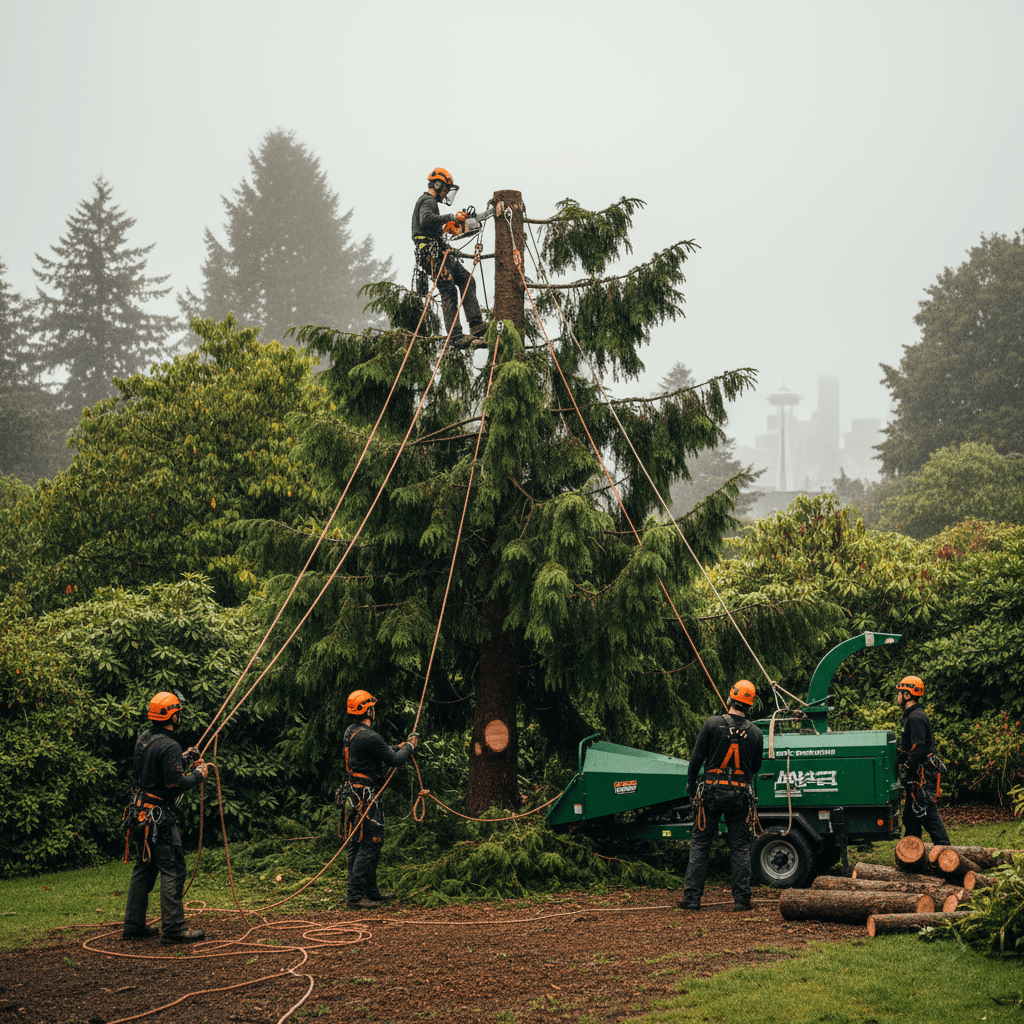
On the day of the tree removal, our experienced and trained crew will arrive at your home prepared with all of the necessary equipment and safety gear. We will then set up a secure work zone, carefully section the tree utilizing the proper rigging techniques, and systematically remove it section by section. Due to the potential hazards associated with trees located in proximity to structures (such as homes, garages, fences, etc.) or in areas with limited access, we employ the use of specialized rigging systems to control each section’s descent into a predetermined area.
Step 6: Stump Treatment
Following the removal of the tree, we will attempt to cut the remaining stump as low to the ground as possible. After the stump has been cut, you can either have us grind the stump down immediately after completion of the tree removal, or we can grind it at a future date when you are ready to landscape the area again. We will review your options with you and assist you in determining which option works best for you.
Step 7: Debris Removal/Cleanup
Once the tree has been removed, we will remove all of the branches, wood, and debris from your property. We will thoroughly rake the area to ensure that it is free of any debris, and you will be able to immediately begin landscaping the area as desired. If you wish to retain the wood for firewood, we will be happy to cut and stack it for you.
Step 8: Final Inspection/Walk Through
Finally, we will meet with you at the end of the project to ensure that you are completely satisfied with the results. We do not consider the job complete until you are completely satisfied with the service we provided.
Methods We Use to Remove Trees
Traditional Sectional Removal
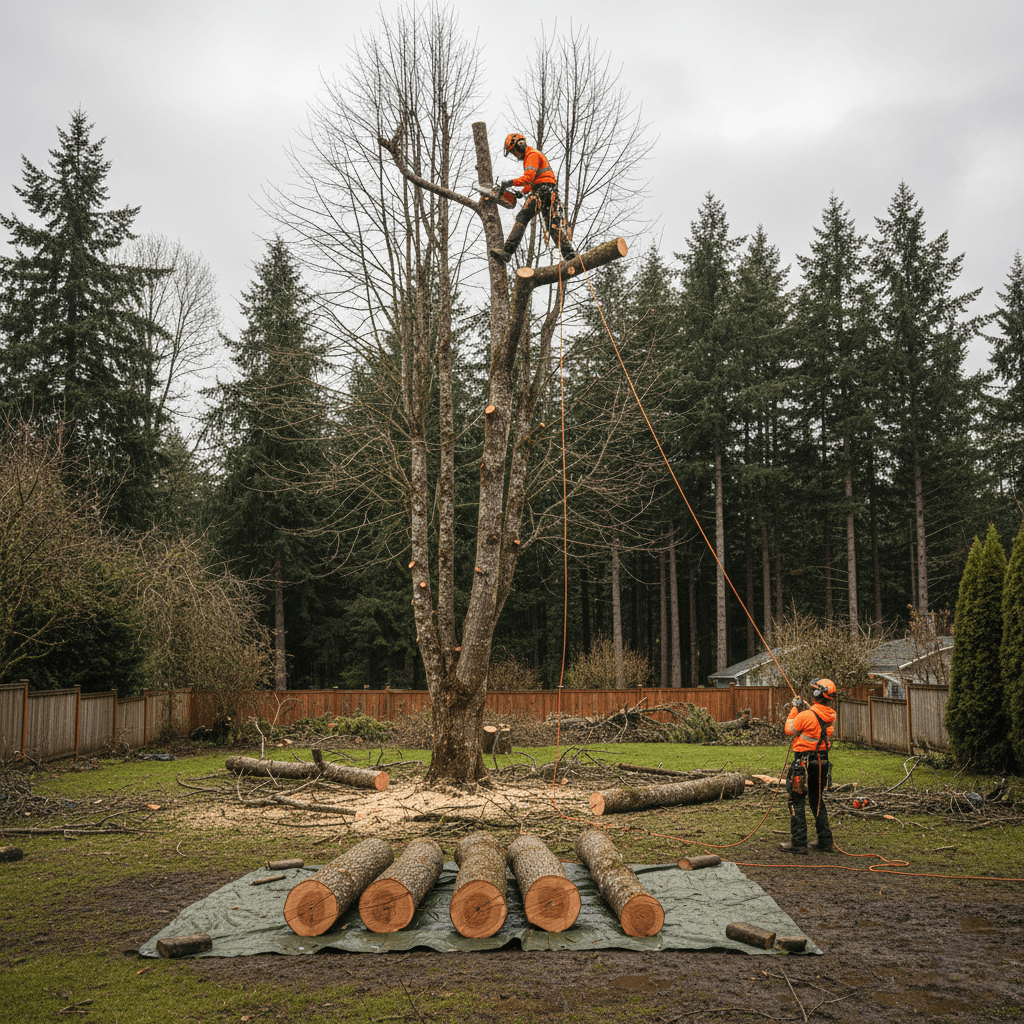
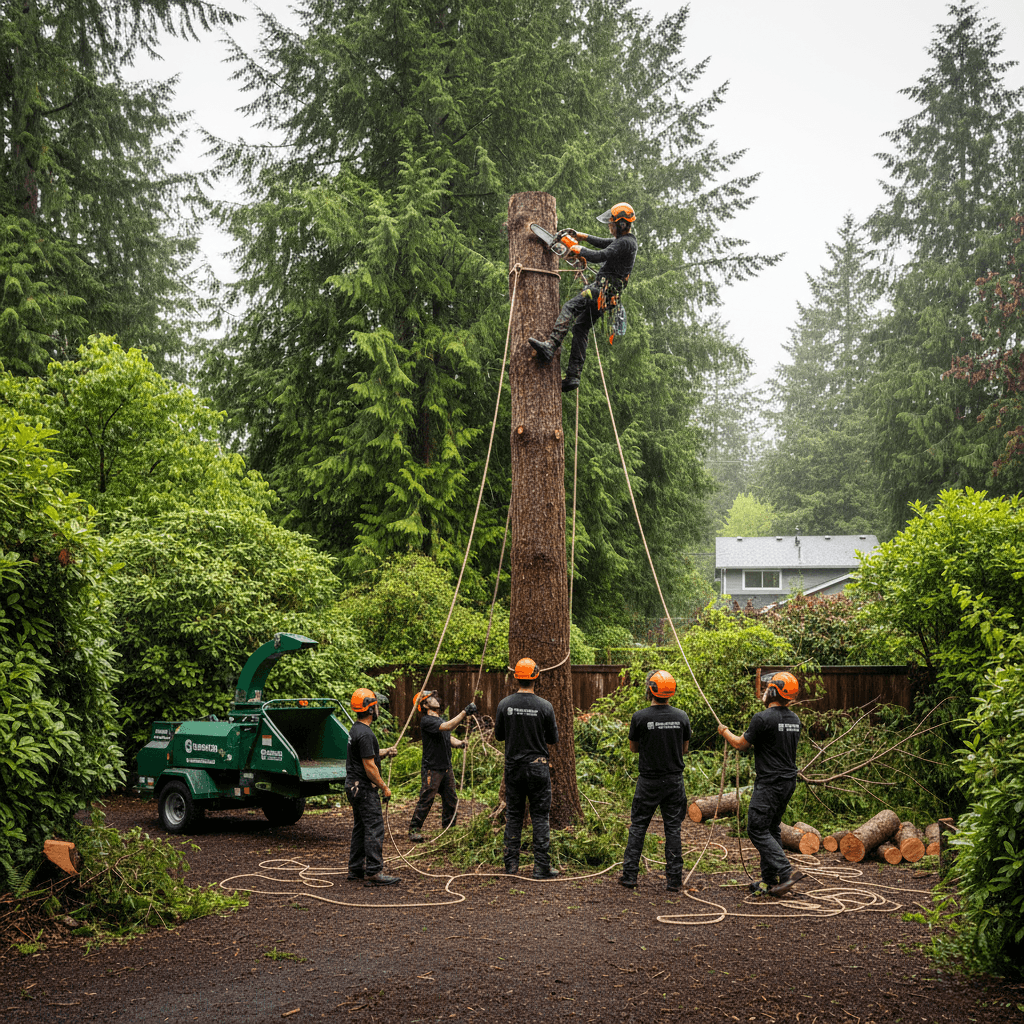
Sectional removal of trees is the most commonly used method for the removal of trees that are located close to other structures. A climber will climb the tree and remove branches from the top down, as they climb the tree, we then use rope and rigging equipment to lower large pieces of the tree as we go, this allows us to have full control on how we bring the tree down to not cause damage to your structures, landscaping, and/or utilities surrounding the area.
Crane-Assisted Tree Removal
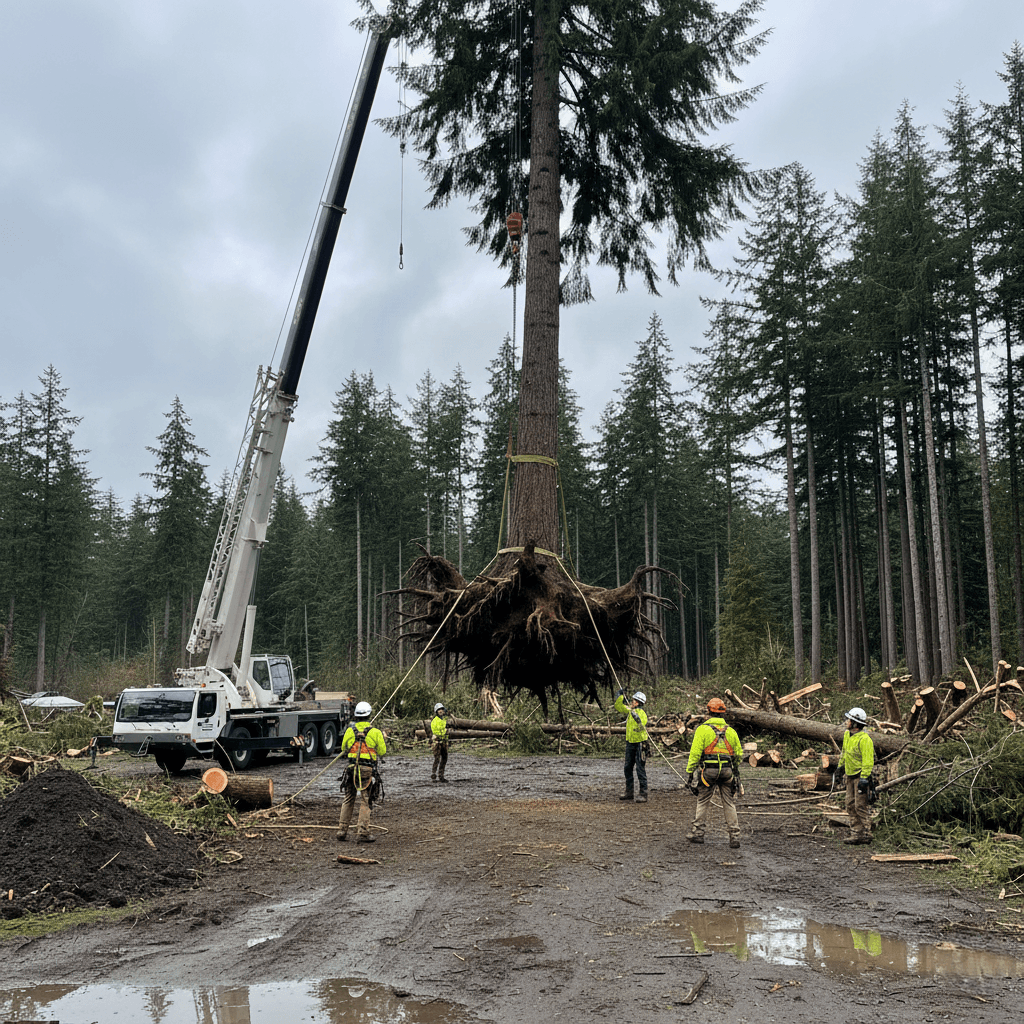
If you have a very large tree that you need removed, if there is a small amount of room around the tree, and/or if you require the greatest degree of accuracy, we can provide crane service to assist with the removal of your tree. The crane will be able to lift the entire section of the tree directly above an obstacle (such as power lines), greatly reduce the risk associated with the job, and potentially allow the job to be completed much faster than it would have been if we had to perform a traditional removal method.
Straight Felling
In situations where we do not have to worry about damaging structures, and we have enough space to safely bring the tree down without causing harm to anything, we may choose to fell the trees. This is typically a quick and efficient way to remove a tree when there is ample open space to do so. Before we fell a tree, we assess all factors, including wind direction, size, and weight of the tree, etc., in order to determine the best direction to safely bring the tree down. In addition to determining the best direction to bring the tree down, we also strategically cut and wedge the tree to ensure the tree falls in the manner we want it to.
Removing Trees Using Rigging
Trees that are in proximity to valuable landscaping, structures, or areas that do not offer adequate drop zones, we use specialized rigging systems to safely and efficiently remove the tree. These systems include ropes, pulleys, and friction devices, which enable us to safely lower the section(s) of the tree into the desired location.